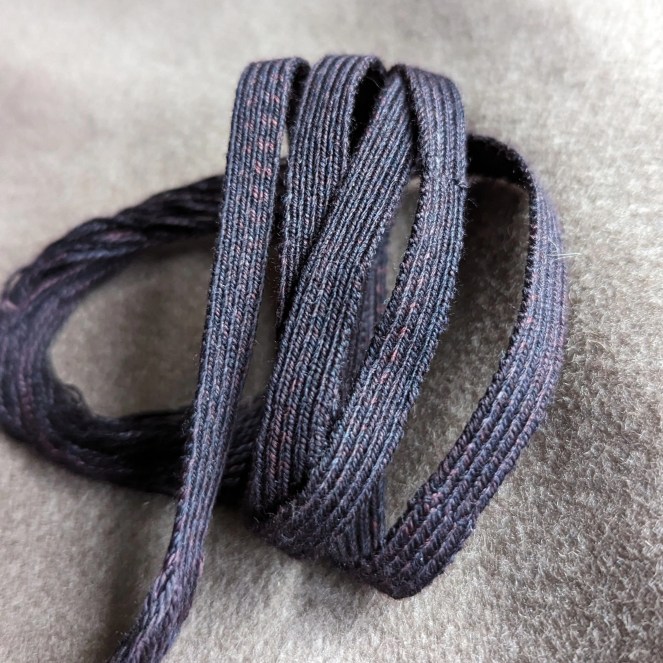
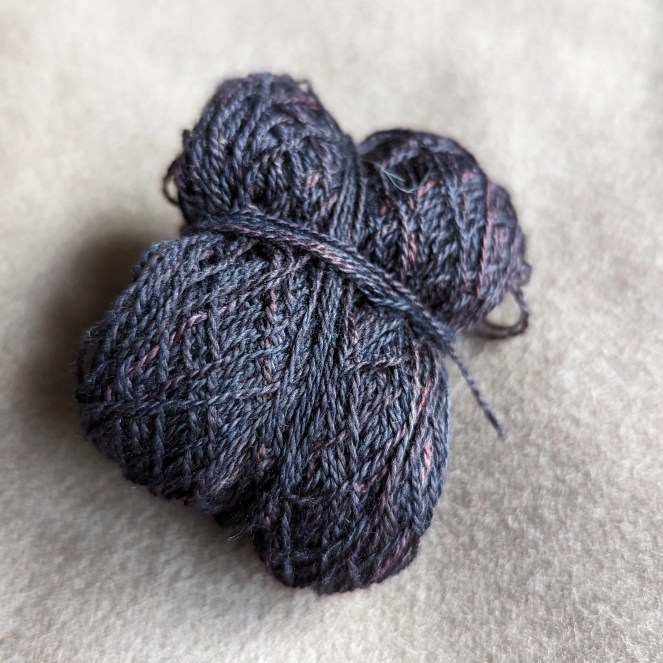
Last summer, during my stay in the Middelaldercentret in Nykøbing, I was approached by one of the other attendants to weave a narrow ribbon for a beautiful hanger she commissioned at a goldsmith. She wanted something very simple, but comfortable enough to support the weight of the hanger. A chain was not suitable because it would cut in her neck, and a simple string would do no justice to the beautiful hanger itself. Because we were there with about 80 people form the Company of St. George, the material for the ribbon was readily available. The dyers had a beautiful assortment of plant-dyed silk yarns, and she picked a lovely dark purple. The yarn wasn’t dyed perfectly even, small areas of slightly lighter red hues show up all through the yarn.
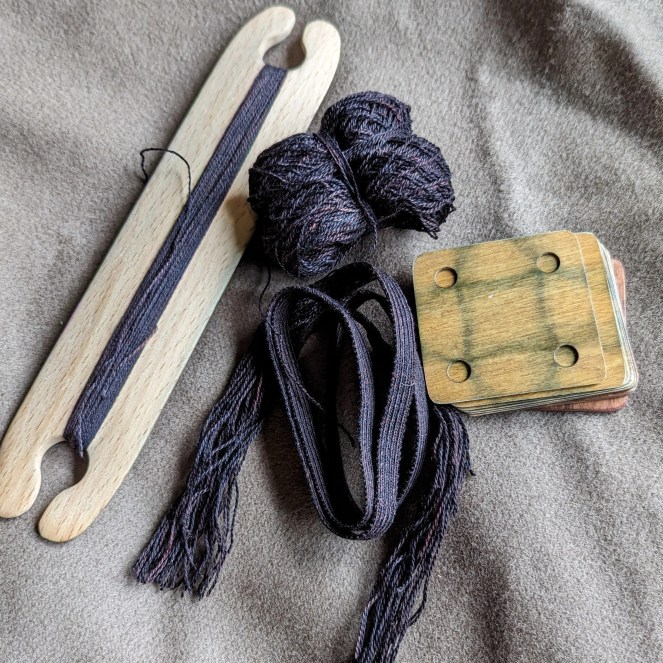
These small variations add an interesting effect to the finished ribbon. In tablet weaving, a thread shows up every 4th turn of the cards. This means that instead of larger patches, the lighter pieces of yarn show up as tiny specs all over the end product. The ribbon was woven with 9 cards in alternating SZ orientation, all threaded with 4 threads and continuously turned forward. When too much twist built up, I flipped the cards and continued weaving. The ribbon ended up about 7 mm wide.
This was my first time weaving with plant dyed yarn, and I immediately noticed one of its unintended side effects. The last dye bath must have been indigo, because my tablets, spool and even my fingers turned blue during weaving! I will make sure to tell this to the person I made it for, so she knows it might stain her skin also during wearing. Overall I liked this small project very much, it really shows that there’s beauty in simplicity.
A few weeks back I reignited my sewing journey with the first make 9 of 2023. That’s right, I plan to have more make 9-like sewing lists! To be honest, I don’t expect to complete all the lists and sew all the things, but setting goal is a useful way for me to plan my year and have a idea of where to start. I seem to suffer from a weird kind of paralysis if I don’t have a plan, so just making a list helps me enormously!
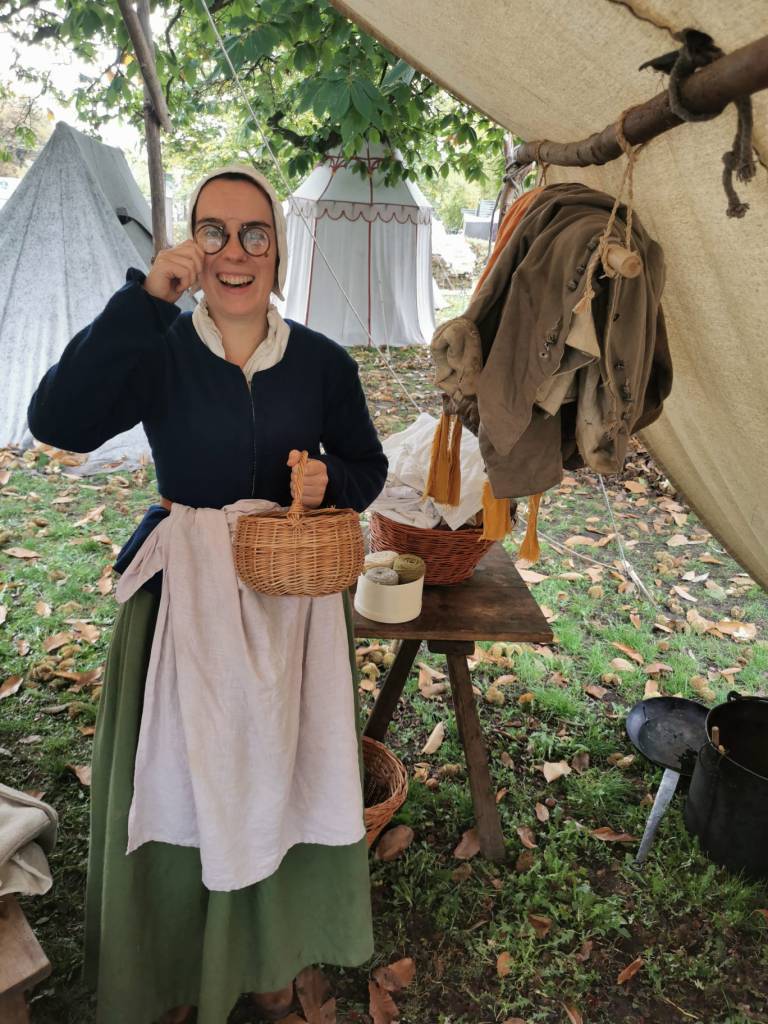
Now on to the title of this post.. 17th century you say, what is this? Well, it’s a part of me that I didn’t write about yet on his blog, but since it consumes a lot of my hobby time, and requires a lot of my sewing skills, I figured I just might as well. One of my most important hobbies for the past 10 years has been reenactment. For the reader unfamiliar with this term: it means to portray a certain place and time in history as accurate as possible, and often it’s focussed on military history. In that regard it is quite different from LARP (playing a fantasy game often set in a historically inspired setting) or the SCA as it is know in the US (selectively recreating pre-17th century european cultural elements). It’s interesting, lots of fun and sometimes it looks silly too, as demonstrated in the picture below.
Hello?
I myself am not very interested in military history, but since history is full of civilians, there is much to choose from! I am a member of a military-oriented group called Compagnie te Voet (Company afoot), which portrays a pikemen division from the Dutch army in the period 1600-1630. This army was usually followed by a large group of civilians or camp followers (similar to the German tross), offering their goods and services to the travelling army. In the past few years our group started to put more energy into this part of the army camp, and we now have a pub, a stall with baked goods, a stall with hot foods, someone selling clay pipes and tobacco, and more on the way. My plan for this year is to start a small sewing and repair business. War is hard on the clothes, and not an event goes by without a burst seam, a sock with multiple holes or a request for a needle and thread to make a quick repair here and there. I am going to look more into detail on how those things were done in an army camp, and will base my research on information on tailors and seamstresses of the time for now.
So what are my goals for this year? Completely in style with my previous post, I made a ‘make 9’ layout. Coming up with 9 projects to work on was easy, but since I know they will take a lot of time, I am pretty sure I will not finish all of them (and that’s ok).
A huik: nothing says Dutch 17th century more than a huik. In this image (“The Fish market”, 1627 by Jacob Gerritsz Cuyp (1594-1652) it is worn by both the lady in the foreground and the lady in the background. This long black cloak-like piece of clothing is very comfortable to wear in colder or wet weather. If you pay attention to them, you see huiken turning up in so many paintings from the time, and you can see why I would need one.
My sewing kit: all the essential tools for tailor and seamstress activities. These were two very distinct jobs in the 17th century, but since I would like to practice both, I will need the tools for both. This requires some in depth research, but I guess one also discovers by doing what is missing. This image is “De kleermakerswerkplaats”, 1621 by Quiringh van Brekelendam (~1622-1669)
A doublet or wambuis: A quintessential part of 17th century men’s wear is the doublet, or ‘wambuis’ in Dutch. About 8 years back I sewed one for my then-boyfriend, and although the fit and looks were fine, I would change many things if I had to do it again. All I had back then was a pattern and my own insights, but I didn’t so much research on construction. I would like to draw a pattern and sew a doublet from scratch again, and see and feel the difference. Image: “Doublet and Breeches, 1625-1635 (made), V&A museum London, Accession number T29&A-1938.
A new or updated dress: As with the wambuis, my first dress was sewn 8 years ago when I still had no real idea what I was doing. I made a second dress since (the one in the photograph of me), but I’m still not completely happy. I think the fit could be improved, but my largest concern is the colour. At the time I bought this fabric, the consensus in our group was ‘all colours that could have been dyed with plants are ok’. In the past years however, by talking to experts and looking at pictures, it is clear that amost dresses are in shades of red, blue, black, and natural tones. My green and yellow dress if definitely not a very common choice, and therefore an update might be required at some point. Image: “#75 A peasant couple and a dog on tiptoe”, ~1620-1626, by Adriaen van de Venne (ca. 1587/1589 –1662), from the British Museum collection, registration number 1978,0624.42.74.
A new bonnet: same story as with the wambuis and dress… it was made 8 years ago from a pattern in the Tudor Tailor, which is a wonderful resource, but it’s English fasion from an earlier period. It kind of looks correct, but it’s not if you look closer. A Dutch bonnet was usually worn with an ‘oorijzer’ or ‘ear-iron’, which is a wire that goes from the temples over the ears and around the back of the head, to which the bonnet is attached. The image included shows the correct shape: a bonnet consisting of two parts, attached to the iron with a small pin at the temples. Image:“Catharina Hooft with her Nurse”, 1619-1620, by Frans Hals (1582/1583-1666), from the Staatliche Museen zu Berlin, Gemäldegalerie, Ident. Nr. 801G.
Underpants: yes, the unmentionables! Curiously, there is not much proof or finds of women’s underwear from this period of time that I know of. For men there are some finds, especially from earlier periods (such as the famous Lengberg castle find). Looking at the situation with my very 21st century view, I think women might have worn something, for their periods and decency. At this moment, usually I don’t wear underpants *gasp* and never experienced exposure, but I think it will be an interesting subject to research, if only to prevent a situation as seen in the image: excerpt from “Ijsvermaak”, 1610, by Hendrick Avercamp (1585-1634), from the Mauritshuis, inventarisnummer 785.
Passementerie course: This is not something to make per se, but something to learn this year. The Textile Research Centre in Leiden offers a course about 17th century passementerie this year, and I would like to participate. It will allow me to make more historically accurate clothing in the end, instead of buying passementerie that is just not it. In addition, I really like to get back into card weaving, and I am told this technique was still used in the 17th century!
Looking at the number of events we have this year, I feel very motivated to complete at least a few of those projects before the season is over. I’m already working on some of them to be honest, so updates soon!

 Dutch Sewing Scientist